The Robots Arrived Before the Rules Did
What a faked humanoid, a €319,000 compliance bill, and a century old economic debate tell us about the physical AI boom

At the World Artificial Intelligence Conference in 2025, a company called Matrix Robotics unveiled its Matrix-1 humanoid to an admiring crowd. The machine moved with uncanny fluidity. It was, as it turned out, uncanny for a reason: critics later described the demonstration as choreographed theatre, with human performers inside the suits.
Set aside the embarrassment for a moment and ask the more interesting question. What kind of market makes faking a robot seem like a rational business decision?
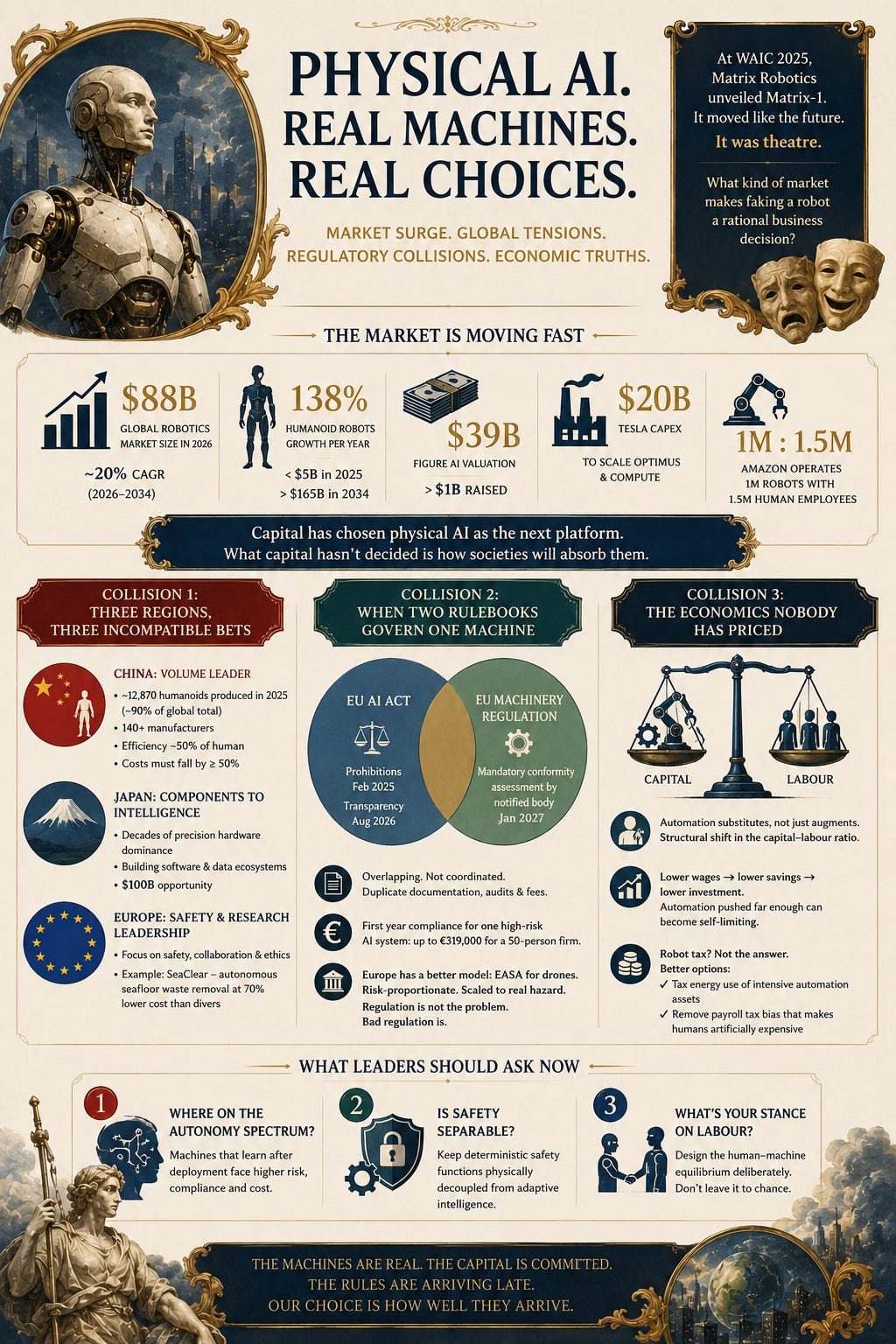
The answer is a market moving faster than its own foundations. The global robotics sector reached roughly 88 billion dollars in 2026, expanding at a compound annual growth rate of nearly 20 percent. The humanoid segment alone is growing at 138 percent per year, projected to climb from under 5 billion dollars in 2025 to more than 165 billion by 2034. Figure AI raised over a billion dollars at a 39 billion dollar valuation. Tesla committed 20 billion dollars in capital expenditure to scale its Optimus robot and the computing infrastructure behind it. Amazon now operates one million warehouse robots alongside one and a half million human employees, a ratio that would have sounded like science fiction a decade ago.
Capital has decided that machines which perceive, reason, and act in the physical world are the next platform. What capital has not yet decided, because it cannot, is how societies will absorb them. Three collisions are now underway, and each deserves the attention of anyone leading an organisation through this transition.
Collision one: three regions, three incompatible bets
The physical AI race is not one race. It is three different games played under three different rulebooks.
China has made embodied artificial intelligence a central pillar of its 15th Five Year Plan. The results are staggering in volume: roughly 12,870 humanoid robots produced in 2025, close to 90 percent of the global total, built by more than 140 active manufacturers riding the same supply chains that power the country’s electric vehicle industry. But volume is not value. Chinese humanoids currently operate at roughly half the efficiency of a human worker, and analysts estimate costs must fall by at least half before commercial viability arrives. The Matrix-1 episode is a symptom of that gap between production numbers and productive capability.
Japan is playing a quieter game: converting decades of dominance in precision hardware, the actuators, motors, and reducers inside nearly every serious robot on earth, into a software and data ecosystem. Its government frames this as a 100 billion dollar opportunity. It is also a hedge, because if general purpose robotics scales globally, the country that owns the components wants to own the intelligence layer too.
Europe has chosen a third position: leadership in safety, collaborative robotics, and research. Projects like SeaClear, an autonomous fleet that removes seafloor waste at 70 percent lower cost than human divers, show what the European model looks like at its best. What it looks like at its worst brings us to the second collision.
Collision two: when two rulebooks govern one machine
A robot that learns is, in European law, two regulated objects at once. Its intelligence falls under the European Union Artificial Intelligence Act, whose prohibitions took effect in February 2025 and whose transparency obligations arrive in August 2026. Its body falls under the new European Union Machinery Regulation, fully mandatory from January 2027, which requires that any machinery whose behaviour evolves through machine learning undergo independent conformity assessment by a notified body.
In principle, both frameworks are defensible. In practice, they overlap without coordinating. Industry studies estimate that first year compliance for a single high risk AI system can reach 319,000 euros for a firm of fifty people, eroding 30 to 40 percent of net profit. Companies building autonomous inspection robots for chemical plants now face duplicate documentation, duplicate audits, and duplicate fees under two regimes assessing largely the same machine. In one particularly surreal case, engineers deploying computer vision that stops a robot cell when a worker enters must audit their industrial sensors against fundamental rights standards written with very different technologies in mind.
There is a better model hiding in plain sight, and Europe built it. The European Union Aviation Safety Agency governs drones through categories proportional to physical risk: weight, speed, and proximity to people determine the compliance burden. A 249 gram drone flown in a field faces an online test; a heavier machine flown over a city faces proctored examination. Nobody audits a hobby drone against the freedom of religion. Regulation scaled to actual hazard is not deregulation. It is regulatory craftsmanship, and physical AI urgently needs it.
Collision three: the economics nobody has priced
The deepest tension is not technical or legal. It is economic, and it revives a debate older than the transistor.
Standard theory holds that technology raises productivity, and productivity eventually creates new work for displaced workers. Physical AI strains that assumption because it does not augment labour at the margin; in a growing set of tasks, it substitutes for labour entirely. McKinsey projected as early as 2017 that some 375 million workers worldwide would need to change occupations by 2030. When a machine is cheaper, more durable, and more predictable than a person, the substitution is not a temporary adjustment. It is a structural shift in the ratio of capital to labour.
Here the academic literature offers a result worth pausing on. In overlapping generations models of the economy, wages are the primary source of household savings, and savings are the primary source of investment. If automation suppresses wage income broadly enough, it can undermine the very investment that long run growth depends on. Automation, pushed far enough without redistribution, becomes self limiting. The machine economy still needs customers.
This is why the robot tax debate refuses to die, and why the crude version of it deserves to. A direct levy on automation punishes process innovation and requires lawyers to define what counts as a robot, an exercise with no stable answer. More promising alternatives exist: taxing the energy consumption of intensive automation assets, or removing the fiscal asymmetry by which payroll taxes make humans artificially expensive relative to machines. The goal is not to slow the machines. It is to stop subsidising the substitution beyond what genuine efficiency justifies.
What leaders should ask now
For executives and policymakers, three questions matter more than any demo.
First, where does the system actually sit on the autonomy spectrum? A machine whose behaviour evolves after deployment carries a fundamentally different risk and compliance profile than one that executes fixed logic, and the difference now has a price measured in six figures.
Second, is the safety architecture separable from the intelligence? Engineering teams that keep deterministic safety functions physically decoupled from adaptive planning software will find both regulators and insurers considerably easier to face.
Third, what is the organisation’s honest position on labour substitution versus augmentation? The firms that thrive through this transition will be those that treat the human and machine equilibrium as a design decision, made deliberately, rather than an outcome that happens to them.
The Matrix-1 performers eventually took off their suits. The rest of us do not have that option. The machines are real, the capital is committed, and the rules are arriving late. The work ahead is to make sure they arrive well.