Architectural Design and Operational Implementation of Autonomous AI Enterprises:
A Framework for Zero-Human Business Intelligence

The paradigm of enterprise process automation is undergoing a structural shift from deterministic, rule-based workflow pipelines toward autonomous, goal-driven multi-agent systems1. Historically, corporate digital transformation relied on robotic process automation (RPA) and hard-coded integration scripts1. While effective for static, high-volume tasks, these legacy systems break down when confronted with unstructured data, unexpected API updates, schema drift, or non-routine operational decisions1.
The emergence of frontier large language models (LLMs) equipped with long-horizon reasoning, cross-session persistence, and multimodal execution capabilities enables the delegation of entire departmental operations to autonomous agent collectives1. A zero-human enterprise or zero-human department represents an integrated computational entity structured around four core operational pillars1:
Goal-Driven Reasoning Agents: Software systems that receive abstract operational mandates, decompose those directives into hierarchical sub-tasks, execute analytical code, evaluate intermediate outputs, and correct errors without human intervention1.
Specialized Role Topologies: Organizational frameworks where distinct agents possess prompts, toolsets, execution environments, and operational boundaries tailored to domain functions like data engineering, statistical modeling, or frontend visualization1.
An Independent Control Plane: An orchestration software layer that operates above individual model runtimes to manage task routing, organizational reporting lines, atomic task distribution, persistent state tracking, and monetary governance5.
An Oversight Interface: A central monitoring dashboard that allows executive management to define high-level strategy, audit execution logs, review deliverables, and enforce financial guardrails1.
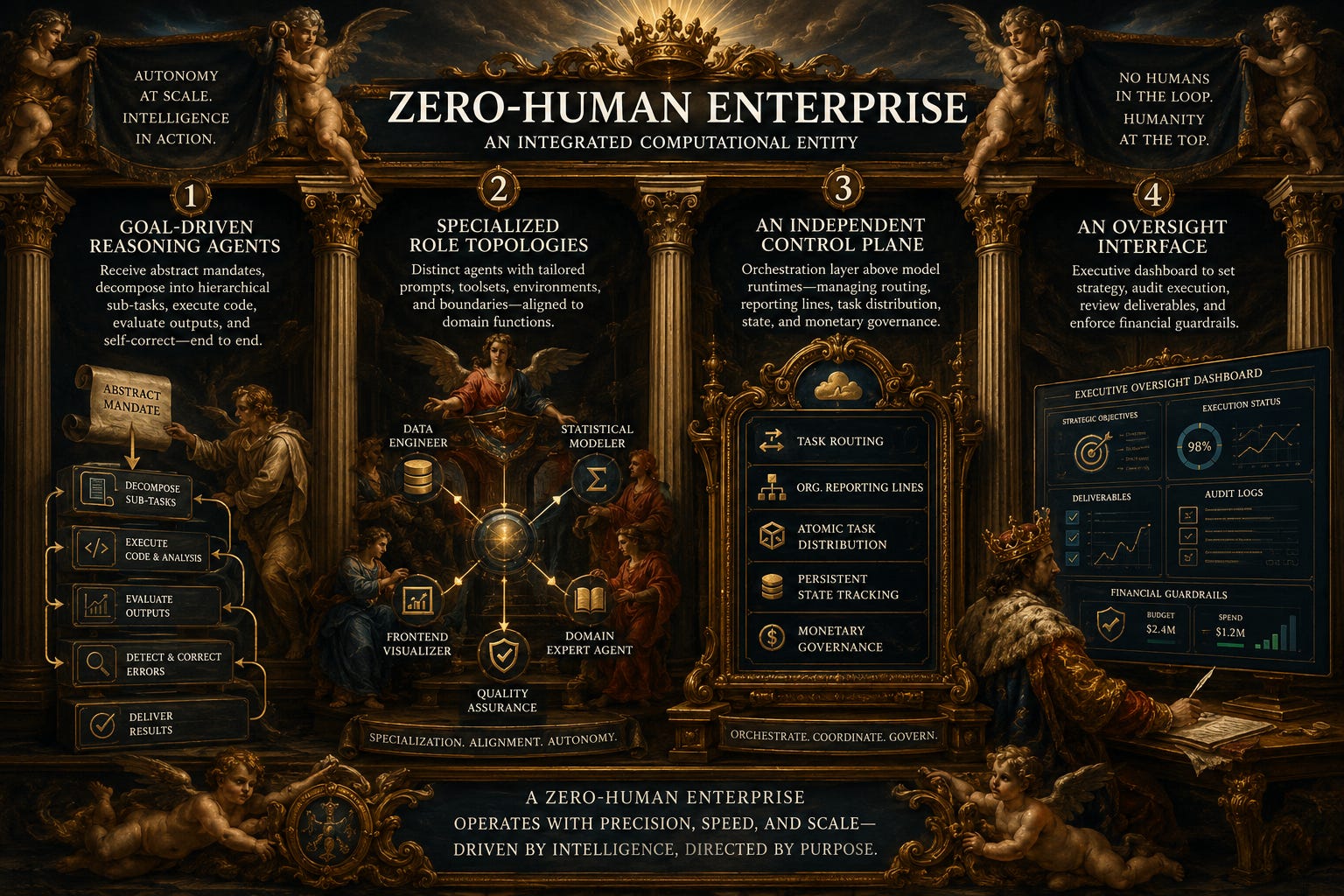
To operators with background in business management, this architecture mirrors traditional corporate management structures5. Instead of directly executing tasks or managing individual human employees, business leaders define corporate strategy, assign goals to departmental leadership agents, set hard operational budgets, and review completed deliverables5. Strategic vision is separated from operational execution through a computational hierarchy1.
The Control Plane Layer: Paperclip Architecture and Governance
Operating multiple autonomous AI agents without a unified control architecture results in severe operational friction5. When organizations attempt to run multi-agent workflows using disconnected terminal sessions or isolated scripts, they encounter token wastage, duplicate work, lost context upon system reboots, and an inability to track costs across agents5.
Paperclip addresses this challenge by serving as an open-source, self-hosted control plane for autonomous businesses5. Built on a Node.js server, React dashboard, and PostgreSQL database, Paperclip sits above individual execution tools and provides the structural governance required to run an agent-based organization5.
Paperclip enforces a separation between the control plane and execution services5. The control plane manages organizational reporting structures, goal tracking, task distribution, atomic task locks, budget cap enforcement, and audit logging5. Execution services are the external agent runtimes—such as Hermes Agent, Claude Code instances, OpenAI Codex, or custom webhooks—that execute code, run database queries, and synthesize reports5. Agents connect to Paperclip via periodic schedule signals (”heartbeats”) or event-driven triggers, checking out assigned tasks and reporting results back to the central server5.
Paperclip structures company operations through goal ancestry5. When a high-level goal is established (for instance, “Publish a daily business intelligence report on customer churn”), Paperclip attaches this corporate mission to every sub-task generated down the hierarchy5. When an individual agent picks up a discrete job, such as writing a database extraction query, the agent receives both the immediate task instructions and the full contextual chain explaining why the task is being performed5. This mitigates context drift across long-horizon executions1.
To prevent operational resource contention and cost overruns, Paperclip incorporates financial and execution safety mechanisms5. Atomic execution locks ensure that when an agent claims a task, an execution lock is placed on that database record, preventing double-work or duplicate API calls6. Persistent state tracking ensures that agents resume work from their last saved context state during heartbeat wakes rather than re-running tasks from scratch5.
Furthermore, Paperclip enforces per-agent spending limits6. Each agent in the org chart is assigned a monthly financial budget6. When an agent reaches 80% of its budget, a soft alert is triggered; at 100% utilization, Paperclip automatically revokes task checkout permissions and pauses the agent’s heartbeat loop until management intervenes or the billing cycle resets5.
Execution Frameworks: Hermes Agent and Self-Improving Nodes
While Paperclip provides organizational governance, execution nodes require agent frameworks capable of persistent, multi-step problem solving5. Hermes Agent, developed by Nous Research, is an open-source, model-agnostic agent framework built for persistent, autonomous operation across server environments12.
Unlike standard conversational AI interfaces that clear context when a session ends, Hermes Agent retains state across restarts using a local SQLite database powered by FTS5 full-text search12. Memory in Hermes is organized across three functional tiers12:
Working Memory: The immediate token context window used during active task execution12.
Episodic Memory: A searchable repository of cross-session interactions, past preferences, historical system configurations, and past debugging logs12.
Procedural Memory (Skills System): Reusable, structured execution workflows dynamically created by the agent after successfully completing complex tasks12.
The defining operational feature of Hermes Agent is its closed-loop learning cycle12. After completing a task involving complex tool execution—such as resolving a broken database pipeline—Hermes enters a self-reflection phase12. It evaluates its execution trace, isolates successful patterns, and crystallizes those steps into a persistent skill document formatted to the agentskills.io open standard (SKILL.md)11.
Observe Strategy ---> Execute Tool Sequence ---> Reflect on Performance ---> Crystallize SKILL.md ---> Reuse in Future Runs
To optimize token efficiency during subsequent runs, Hermes uses a progressive disclosure strategy for its skill memory12:
Metadata Tier: The agent loads only the skill name and a high-level summary into its core context window (~20 tokens)12.
Specification Tier: If active task parameters match the skill summary, parameter definitions and usage constraints are loaded (~200 tokens)12.
Execution Tier: The full command sequences, template code, and edge-case handling routines are injected into active memory (~1,000+ tokens)12.
Hermes Agent bridges technical execution and user interaction through a multi-platform gateway supporting over 20 communication channels, including Telegram, Slack, Discord, Feishu, and native command-line interfaces11. A single Hermes instance can execute server-side data workflows in a cloud sandbox while providing continuous status updates to executive teams via enterprise chat applications11.
For security during code execution, Hermes supports multi-backend isolation, allowing commands to run inside hardened Docker containers, remote SSH instances, or serverless environments like Daytona and Modal11.
Frontier Intelligence Engines: Model Capabilities and Enterprise Connectors
A zero-human departmental stack relies on frontier foundation models to execute reasoning, coding, and visual layout tasks3. Integrating different models based on their core strengths optimizes execution accuracy and token spend3.
Anthropic’s Claude models and Claude Code CLI interfaces excel at multi-step reasoning, architectural planning, and enterprise tool integration5. A key standard within this ecosystem is the Model Context Protocol (MCP)11. MCP establishes an open standard for securely connecting LLM agents to internal enterprise infrastructure, such as PostgreSQL, Snowflake, BigQuery, and local file repositories17. Through MCP, agents can discover database schemas, inspect data tables, and run parametric queries without requiring custom API integration code for every tool11.
Moonshot AI’s Kimi ecosystem provides model capabilities tailored for long-horizon data processing, agent swarms, and visual rendering3.
The Kimi K2 Thinking series addresses a critical limitation of standard conversational models: degradation during extended, multi-step execution loops3. By sustaining coherent reasoning over hundreds of sequential tool invocations, Kimi K2 Thinking can execute statistical analyses, isolate anomalies, write validation code, and refine data models in a single run3.
Kimi K2.6 expands this with Agent Swarms, allowing up to 50 specialized sub-agents to operate in parallel on split data tasks, consolidating their outputs into React interfaces, editable slides, or structured reports4. Kimi K3 adds visual-in-the-loop reasoning, enabling the model to inspect screenshots of its rendered dashboard interfaces, identify formatting errors, and fix CSS layout issues before final delivery7.
Implementation Blueprint: Building a Zero-Human Business Intelligence Department
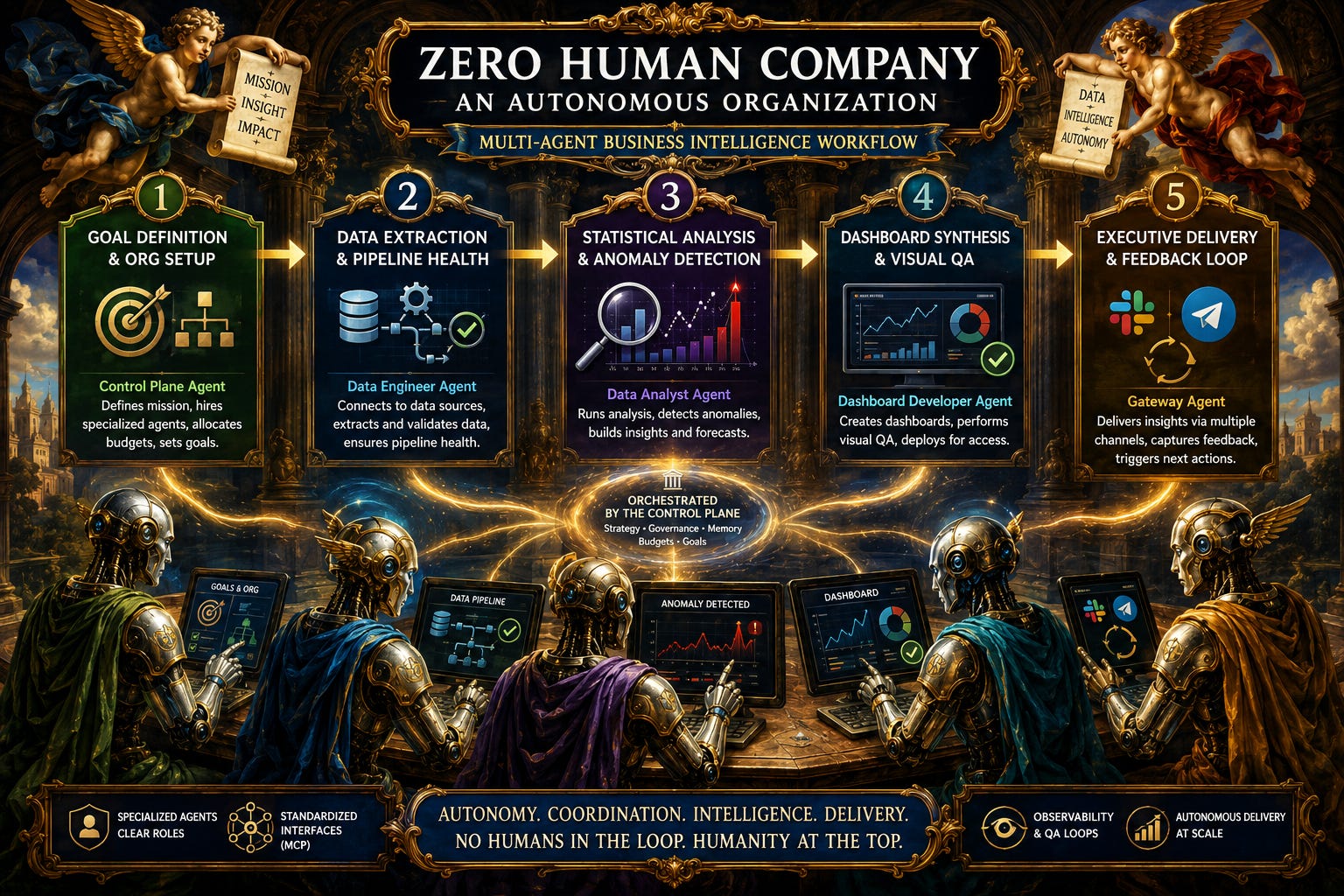
To illustrate how these frameworks function together, the following walkthrough details the implementation of an autonomous, zero-human Business Intelligence (BI) department5. The department automatically ingests raw transactional data, runs statistical analyses, detects metrics anomalies, generates interactive web dashboards, and delivers natural-language executive briefings4.
Phase 1: Organizational Setup in Paperclip
The department owner deploys Paperclip on a self-hosted virtual server and creates a company entry titled Autonomous Business Intelligence Unit5. The primary company goal is assigned: “Continuously ingest enterprise transactional data, analyze daily revenue performance, isolate customer retention anomalies, and publish interactive daily BI dashboards with executive briefings.”5
The operator configures four specialized roles within the Paperclip organization chart5:
BI Operations Manager (bi-lead): Managed via a Claude Code adapter5. Responsible for decomposing high-level mandates into sub-tasks and reviewing completed agent deliverables5. Budget cap: $150/month6.
Data Engineer (data-eng): Powered by Hermes Agent running in a local Docker container11. Responsible for database connectivity, SQL extractions, and data cleaning6. Budget cap: $100/month6.
Statistical Data Analyst (data-analyst): Powered by Kimi K2 Thinking via OpenRouter3. Responsible for time-series analytics, cohort calculations, and root-cause anomaly detection4. Budget cap: $150/month6.
Dashboard Builder (bi-visualizer): Powered by Kimi K2.6 / K33. Responsible for compiling web dashboards in React and Tailwind CSS and generating executive text summaries4. Budget cap: $100/month6.
Phase 2: Ingestion and Pipeline Execution via Hermes
The operation initiates on a 6-hour schedule managed by Paperclip’s heartbeat engine6. The data-eng agent (Hermes) receives a wake signal, checks out the data extraction task, and obtains an atomic execution lock from Paperclip5.
Hermes connects to the corporate PostgreSQL database using an MCP connector11. It executes SQL queries to extract incremental sales, user subscriptions, and churn logs for the preceding 24 hours11. If a database schema update causes a query error, Hermes triggers its internal reflection loop12. It analyzes the database error log, inspects the updated table schema, rewrites the SQL transformation script, and verifies the output inside its sandboxed container11.
Once resolved, Hermes crystallizes the working transformation script into a SKILL.md document stored in its local memory directory12. Subsequent extraction runs execute this procedural skill directly12. The staged, cleaned data is saved to a shared staging repository, and Hermes updates the task status to complete in Paperclip5.
Phase 3: Analytical Processing via Kimi K2 Thinking
Paperclip processes the task completion, updates the goal dependency graph, and assigns the analytical task to data-analyst (Kimi K2 Thinking)3.
Kimi K2 Thinking reads the staged dataset and initiates an analytical chain using a sandboxed Python execution environment4. Across multiple sequential tool calls, the model executes a statistical analysis4:
It computes daily recurring revenue (DRR) and decomposes the time series into baseline trends and variance4.
It builds user retention matrices across 30-day, 60-day, and 90-day acquisition cohorts4.
It detects statistical anomalies, identifying a localized 14% conversion drop in regional checkout flows4.
The analysis results, statistical metrics, and identified anomalies are formatted into a structured data payload and committed back to Paperclip5.
Phase 4: Visualization Synthesis and Visual QA
Paperclip routes the output payload to bi-visualizer (Kimi K2.6 / K3)5. Kimi K2.6 converts the structured metrics into a dynamic, single-page React application utilizing interactive Tailwind charts and structured metric cards4.
To verify interface quality, Kimi K3 executes a visual validation step7. It renders the React application in a headless browser, captures a high-resolution screenshot, and visually inspects the interface layout7. Upon identifying a mobile chart overlapping a text label, the model adjusts the underlying Tailwind flexbox layout code, re-renders the page, verifies visual alignment, and builds static production assets to a web server4.
Phase 5: Delivery and Conversational Interface
Once the dashboard web assets are published, the final deliverable is passed to Hermes Agent’s messaging gateway11. Hermes dispatches an executive natural-language summary containing key metric highlights, identified anomalies, and a direct URL to the live dashboard across the company’s Slack and Telegram leadership channels11.
When an executive posts a follow-up question in the Slack channel (such as “Break down the APAC conversion drop by customer tier”), the message is captured by Hermes Gateway and posted as an event trigger to Paperclip6. Paperclip reactivates the data-analyst agent, which executes the required query breakdown and replies in the Slack thread without human management intervention6.
Governance, Risk Mitigation, and Cost Control Frameworks
Operating an autonomous business unit requires structural mechanisms to manage operational risks associated with multi-agent infrastructure1.
Data Privacy Violations
Sensitive corporate credentials leaked to external SaaS orchestration layers6.
Fully self-hosted local control plane (Postgres) and local SQLite memory storage6.
Runaway API expenditure represents a primary operational risk in multi-agent deployments5. If an agent encounters an unhandled exception within a tool execution loop, it can consume hundreds of dollars in API tokens in minutes5. Zero-human control frameworks defend against this by combining Paperclip’s central spending limits with atomic task leasing5.
Task leases assign a finite execution window to every task checkout6. If an agent fails to report progress within its lease window, the task is locked, paused, and flagged for review6. If token consumption exceeds the assigned agent budget, Paperclip cuts off execution access at the control plane level5.
Data sovereignty and system security are maintained by self-hosting the core control plane and memory components6. Paperclip and Hermes store state, configuration settings, memory histories, and credentials inside local databases on private enterprise infrastructure6. Code execution occurs inside sandboxed Docker containers configured with read-only root filesystems, resource usage limits, and restricted network permissions, isolating production environments from arbitrary code errors11.
Conclusions and Strategic Outlook
The construction of zero-human departments is made possible by combining independent orchestration platforms, persistent execution nodes, and specialized frontier AI models3. Paperclip provides the enterprise control plane—enforcing organizational hierarchies, goal alignment, atomic execution locks, and monetary governance across multi-agent workflows5. Hermes Agent provides self-improving operational execution, utilizing long-horizon SQLite memory, progressive skill crystallization, and multi-channel messaging gateways to handle background task processing11. Specialized frontier models like Anthropic’s Claude and Moonshot AI’s Kimi provide reasoning, sequential tool execution, visual layout evaluation, and data extraction capabilities3.
For business operators, this architecture changes the nature of departmental scale1. By structuring operations around goal ancestry, modular execution tools, and control plane governance, organizations can deploy autonomous departments that handle end-to-end business workflows1. Strategic leadership shifts from managing day-to-day execution to setting corporate goals, reviewing performance outputs, and allocating financial budgets across autonomous agent systems1.
Works cited and further readings
What Is Paperclip? The Open-Source Framework for Running a Zero-Human AI Company, https://www.mindstudio.ai/blog/what-is-paperclip-zero-human-ai-company-framework
The Best Practice of Moonshot AI in Massive Data Preprocessing for the Kimi Large Model, https://www.alibabacloud.com/blog/602119
What Is Moonshot AI? Company, Kimi AI & Everything You Need to Know - Bleap, https://www.bleap.finance/blog/what-is-moonshot-ai
Kimi K2: Open Agentic Intelligence - Moonshot AI, https://moonshotai.github.io/Kimi-K2/
What is Paperclip?, https://paperclipai-paperclip.mintlify.app/introduction
What Is Paperclip AI? Features, Pricing, and Alternatives Compared [2026] | Contabo Blog, https://contabo.com/blog/what-is-paperclip-ai/
Kimi K2.6 | Leading Open-Source Model in Coding & Agent, https://www.kimi.com/ai-models/kimi-k2-6
Paperclip: Open-Source Agent Orchestration Platform for Multi-Agent Business Automation - ZenML LLMOps Database, https://www.zenml.io/llmops-database/open-source-agent-orchestration-platform-for-multi-agent-business-automation
Open‑Source Multi‑Agent AI Orchestration Platform - SoftRankings, https://softrankings.com/products/paperclip
Paperclip – The app people use to manage AI agents for work, https://paperclip.ing/
Hermes Agent Documentation, https://hermes-agent.nousresearch.com/docs/
What Is Hermes Agent? - Tencent Cloud, https://www.tencentcloud.com/techpedia/143930?lang=en
Hermes Agent | OpenRouter, https://openrouter.ai/apps/hermes-agent
Hermes Agent — Open-Source AI Agent with Persistent Memory, https://hermes-agent.org/
Hermes Agent : A Practical Guide — and How It Stacks Up Against OpenClaw & GoClaw - DEV Community, https://dev.to/truongpx396/hermes-agent-the-self-improving-agent-framework-and-how-it-compares-to-openclaw-goclaw-22mc
NousResearch/hermes-agent: The agent that grows with you - GitHub, https://github.com/nousresearch/hermes-agent
What is a model context protocol (MCP) server? | Dremio, https://www.dremio.com/blog/what-is-a-mcp-model-context-protocol-server/
Kimi K2 Thinking: what 200+ tool calls mean for production - Lambda, https://lambda.ai/blog/kimi-k2-thinking
Kimi K3 Tech Blog: Open Frontier Intelligence, https://www.kimi.com/blog/kimi-k3
Hermes Agent | Nous Research, https://hermes-agent.nousresearch.com/