ADAPT: How Humans Actually Learn to Work With AI
A field-tested framework for building real measurable AI competence

Every organization I work with has solved the easy problem. They have bought the licenses, rolled out the pilots, and put a chatbot icon in the corner of every screen. What almost none of them have solved is the hard problem: turning access into competence.
This distinction matters more than most leadership teams realize. A KPMG and UT Austin study of 1.4 million workplace AI interactions across more than 2,500 employees found that only about 5 percent of users exhibit the behaviors that separate high-impact AI use from casual dabbling: frequency, persistence, ambition, and intentionality. The other 95 percent have the same tools. They simply never learned how to use them.
That gap is not a technology problem. It is a human development problem. And human development problems require a developmental framework, not a software rollout plan.
This is why I built ADAPT.
Why AI Adoption Needs Its Own Learning Theory
Every prior technological shift forced people to learn something new. The Industrial Revolution taught people to operate machines. The Digital Revolution taught people to operate computers. Both were teachable in a fairly linear way, because the technology itself was static enough to document, train, and certify against.
AI breaks that pattern. It does not sit still long enough to be reduced to a manual. A model that seemed limited in January can outperform expectations by June. This means organizations cannot rely on a single training event and call the job done. What they need instead is a framework for continuous human capability development, one that treats AI fluency the way we treat any complex professional skill: as something built in stages, through deliberate practice, over time.
ADAPT borrows its intellectual lineage from thinkers who have shaped how we understand skill acquisition and change. It sits comfortably alongside Kolb’s experiential learning cycle, Bandura’s work on self-efficacy, and Kotter’s stages of organizational change. But its specific purpose is narrower and, I would argue, more urgent: mapping how a person moves from not knowing what they do not know about AI, to reshaping their entire professional practice around it.
The Five Stages of ADAPT
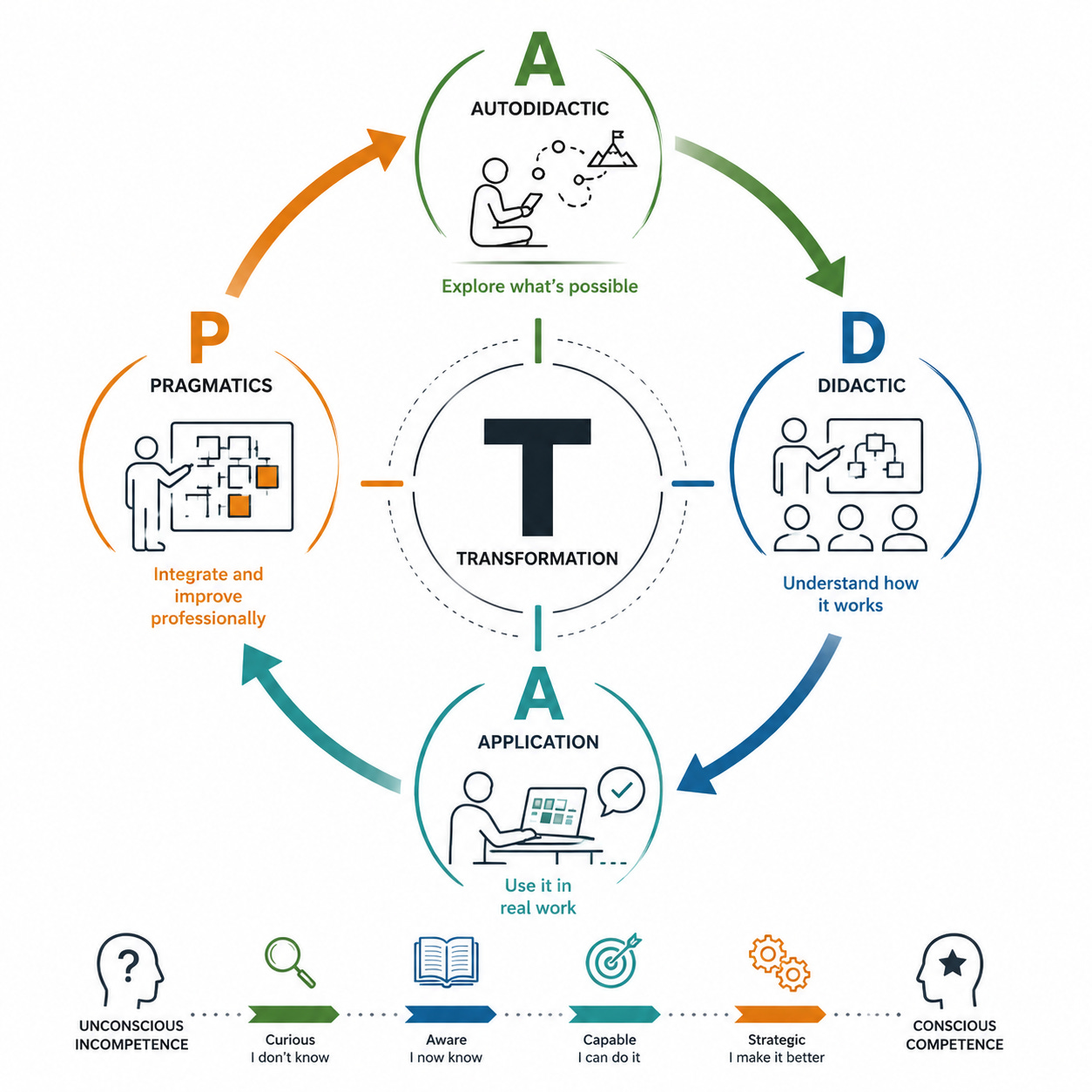
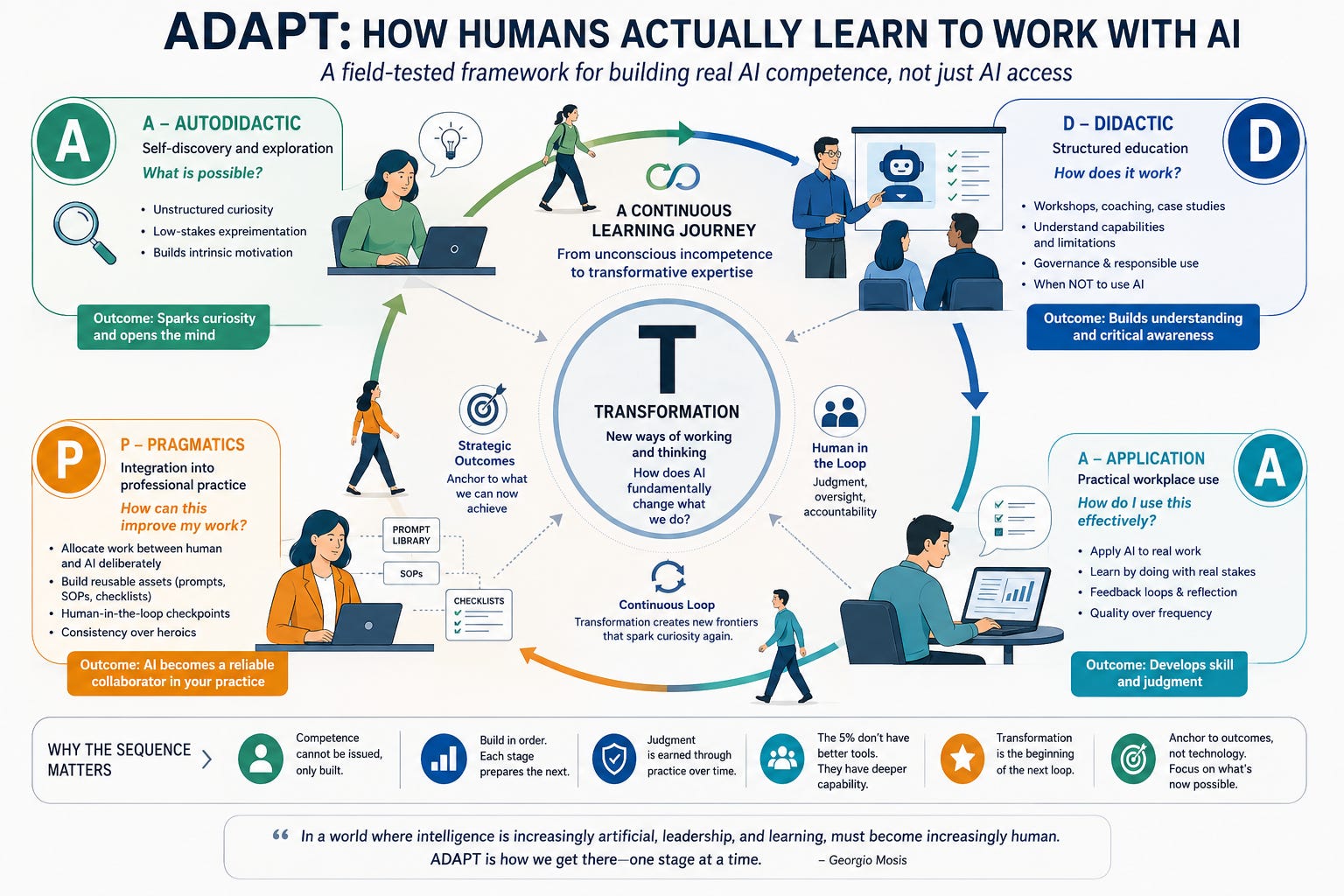
ADAPT stands for Autodidactic, Didactic, Application, Pragmatics, and Transformation. Each stage answers a different question, and each corresponds to a recognizable point on the classic competence curve, from unconscious incompetence to what I call transformative expertise.
StagePurposePrimary QuestionA – AutodidacticSelf-discovery and explorationWhat is possible?D – DidacticStructured educationHow does it work?A – ApplicationPractical workplace useHow do I use this effectively?P – PragmaticsIntegration into professional practiceHow can this improve my work?T – TransformationNew ways of working and thinkingHow does AI fundamentally change what we do?
Let’s walk through each one, with tips you can apply immediately, whether you are guiding a team of fifty or simply trying to grow your own capability.
A — Autodidactic: Curiosity Before Instruction
Every genuine learning journey starts before anyone teaches you anything. In the Autodidactic phase, people experiment on their own. They open a chat window, ask an odd question, generate an image, ask AI to summarize something they already understand well enough to judge the output. They make mistakes with no stakes attached.
This phase is deliberately unstructured, and that is the point. Curiosity that arrives before instruction produces intrinsic motivation, which is a far more durable fuel than a mandatory training module ever will be.
Practical tips:
Do not open an AI initiative with a workshop. Open it with unsupervised access and permission to play.
Give people low-stakes, personally relevant tasks to try first: summarizing their own inbox, drafting a message they were already going to write, generating an image for a personal project.
Resist the urge to correct people’s mental models too early. Some productive confusion here makes the next stage land harder.
D — Didactic: From Curiosity to Understanding
Curiosity without guidance produces confident misconceptions. This is the stage where structured education enters: workshops, coaching, case studies, demonstrations, and honest conversation about limitations.
This is also where people typically discover conscious incompetence. They realize the field is larger and more nuanced than their first fifteen minutes suggested. That discomfort is not a failure of the training. It is the training working.
Practical tips:
Teach the failure modes as deliberately as you teach the capabilities. People trust AI more, not less, once they understand where it breaks.
Cover governance and responsible use here, not as an afterthought bolted on later. It belongs in the foundation.
Explicitly teach when not to use AI. A framework that only teaches adoption, without teaching restraint, is not complete.
A — Application: Learning by Doing
Understanding becomes competence only through repetition against real stakes. In the Application phase, people bring AI into authentic work: drafting reports, analyzing data, preparing decks, supporting a decision they are actually accountable for.
This is where feedback loops matter most. Competence here is visible, not theoretical. You can watch someone get better at prompting, at judging output quality, at knowing what to keep and what to discard.
Practical tips:
Build in structured reflection after each use, even something as simple as “what did I have to fix, and why.”
Pair less experienced users with colleagues further along the curve. Application accelerates through observation almost as much as through doing.
Track quality of output, not frequency of use. Frequency without judgment is not competence.
P — Pragmatics: From Tool Use to Professional Practice
Somewhere in this stage, the question changes. People stop asking “can AI do this?” and start asking “what is the right allocation of work between me and the system?” That shift, from novelty to judgment, is the marker of Pragmatics.
This is where I place the Human-AI Role Allocation Matrix in my own consulting work: a structured way of deciding, task by task, what belongs to the human, what belongs to the machine, and where the two need to work in tandem. Pragmatics is where AI stops being a tool you reach for and becomes a collaborator you route work through deliberately.
Practical tips:
Build reusable assets: prompt libraries, standard operating procedures, review checklists. Pragmatics rewards repeatability.
Institutionalize a human-in-the-loop checkpoint for anything irreversible or judgment-dependent. Never delegate the decision itself, only the pattern-rich work that supports it.
Measure this stage by consistency, not by heroics. A team at Pragmatics produces reliable quality even on an ordinary Tuesday.
T — Transformation: Redesigning Work
Transformation is reached not when AI helps people do their old jobs faster, but when it changes what the job is. Roles get redesigned. Processes get rebuilt around a different division of labor. Teams create forms of value that the previous operating model could not have produced at all.
This is the stage most organizations claim to want and skip straight to, without doing Autodidactic, Didactic, Application, or Pragmatics first. It does not work that way. Transformation without the preceding stages is not transformation. It is disruption without competence underneath it, and it tends to collapse under its own ambition.
Practical tips:
Do not attempt Transformation-level redesign with a team still operating at Application. Check the stage honestly before committing to the redesign.
Treat Transformation as a beginning, not a finish line. Every transformed process creates a new frontier of things worth being curious about, which loops back to Autodidactic.
Anchor the redesign to strategic outcomes, not to the technology itself. The question is never “how do we use more AI.” It is “what can we now achieve that we genuinely could not before.”
Why the Sequence Matters More Than the Speed
The temptation, especially among ambitious organizations, is to compress this journey. Skip the exploration, skip the structured education, go straight to a transformation roadmap with a consulting deck attached. I understand the appeal. It photographs well in a board presentation.
It also fails reliably, for a simple reason: competence cannot be issued, only built. You can mandate access to a tool in an afternoon. You cannot mandate the judgment to use it well. That has to be earned, stage by stage, through the kind of deliberate practice Anders Ericsson spent a career documenting in other domains.
This is also precisely why the 5 percent figure from the KPMG and University of Texas Austin research does not surprise me. Most organizations hand out Autodidactic-level access and expect Transformation-level results. ADAPT exists to close that gap honestly, one stage at a time.
Where This Fits Into the Larger Picture
I think of ADAPT as the learning engine underneath the governance and strategy frameworks I use elsewhere in my work, including AI adoption Playbooks and the Human-AI Role Allocation Matrix. Governance tells you what should happen. ADAPT tells you how people actually become capable of making it happen. Without the second, the first is aspiration on paper.
The closing thought I keep returning to, in leadership conversations and in the classroom alike, is this: in a world where intelligence is increasingly artificial, leadership, and learning, must become increasingly human. ADAPT is my attempt to give that idea a practical shape, one stage at a time.
The "ADAPT" framework is very interesting, professor Mosis. I am curious to your opinion about what Jen-Hsun Huang has explained recently: The amount of AI-credits on the vacancy as a promotional plus on the secundary conditions (next to days of holiday, vitality budget etc.). How does the amount of AI-credits play a role in the "ADAPT" framework? Personally, I am sometimes already out of credits in the exploration phase to see what AI can and what it can't before I embed it in my daily work.
Warm regards, Biem